

Identity Gravity: Why Comfort is Self-Sabotage in Disguise
Why your nervous system treats sudden success as a threat, and how to stop subconsciously blowing up your own progress to get back to a familiar struggle.

Comfort is self-sabotage in disguise. Every time you seek comfort—whether it is reaching for the small screen, a familiar snack, a reality show, or even deciding to stay in a job that you hate—you are limiting yourself.
We generally think of sabotage in dramatic terms: the executive who blows up a massive deal at the 11th hour, or the trader who liquidates a winning portfolio on a reckless impulse. But those catastrophic events are usually just the final, visible symptoms of a disease that has been quietly spreading for years.
There are two distinct orders of self-sabotage, and the one that ultimately destroys your potential is not the dramatic explosion. It is the silent erosion of your daily routine.

The First Order: Death by a Thousand Cuts
First-order self-sabotage is quiet. It operates under the guise of procrastination and perfectionism. These smaller acts gradually erode your progress, akin to death by a thousand cuts.
It is easy to confuse many of our daily, routine activities as legitimate pursuits, hobbies, or recreational downtime, when more often than not, they are carried out for the sole purpose of seeking comfort and safety. If you dig deeper into whyyou are really doing these things, a clear pattern emerges.
Recently, right in the middle of a work session, I found myself meticulously organizing my Netflix “My List.” I have liked TV since I was young and consider myself somewhat of a connoisseur. It is a master file of series I carefully curate to ensure I only watch “quality” material. But I decided to pause and inquire further into the actual cause of this interruption.
I realized I wasn’t performing “maintenance” on a hobby. I was seeking comfort and safety. It was both procrastination and an expression of my perfectionist tendencies. At the end of the day, it served no actual purpose and added zero real value. I would have been far better off simply sitting still and clearing my mind.
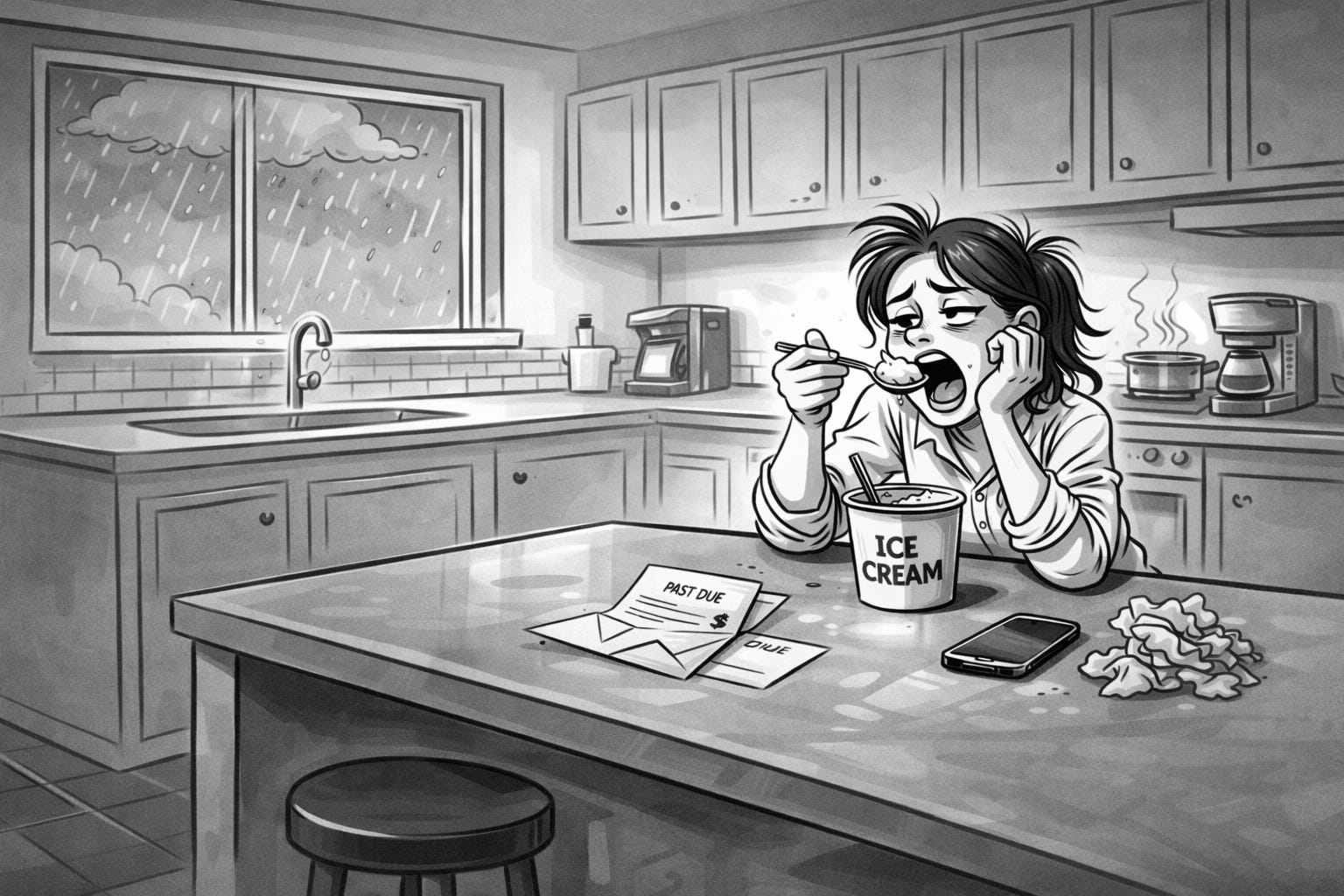
This does not mean that watching a TV show or having a scoop of ice cream is literally always self-sabotage. We require recreational activities and ways to rest the brain. But doing these comforting activities on a recurrent, compulsive basis forms the foundation of a slow self-sabotage pattern.
It is browsing the internet in the middle of the day simply to decompress after a long, stressful meeting. It is picking a fight with your partner at home after an unusually intense day. It is heading to the refrigerator for a snack when you promised yourself you would watch your diet.
These are not moral failings; they are biological coping mechanisms. And they set the stage for the second order.
The Second Order: The “Upper Limit” and the Wealth Trap
Second-order sabotage involves big acts that have an immediate, massive impact. This usually occurs immediately after a big win: getting a major promotion and a raise, closing a major funding round, or signing a massive contract.
This is what is referred to as “Upper Limit” self-sabotage. We have all been there.
In the world of wealth building and trading, this phenomenon is chronic. A classic way to self-sabotage after success is to continue spending all of your income even after you have doubled it, using the justification that you “deserve it” for all your hard work. You overspend simply because you reached the income level you aimed for when you started your career.
Consider the archetype of the founder who finally sells his business, or the executive who reaches the cliff on a massive, life-changing equity grant. The financial pressure that drove them for a decade is entirely gone. Logically, they should feel profound peace. Instead, the sudden absence of the struggle creates a psychological vacuum. To fill it, they start manufacturing chaos. They decide they don’t need to care about expenses anymore, start flying their extended family first-class everywhere, and book extravagant $150,000 vacations—spending wildly above what they previously considered reasonable.
They aren’t enjoying their wealth; they are subconsciously trying to burn it down to return to the familiar feeling of the grind.
I see it in my own history. I grew up in an environment of upper-income scarcity. On paper, the resources were there, but the internal narrative was that there was “never enough.” The emotional baseline was a constant state of anxiety about money. When I eventually made significant money in my corporate career, I threw a lot of it away. Why? Because the presence of abundant capital violated my internal narrative of scarcity.
Even today, in my daily trading, I have to fight this exact same mechanism. I can execute a brilliant setup, secure the profit, and instantly feel the urge to take a reckless, low-probability trade to give the money right back to the market.
The Biology of Sabotage: Regression to the Mean
The reason you do this is that you hit your upper limit, and your nervous system regulates you to return to what it knows.
The human brain is, fundamentally, a prediction machine. It constantly anticipates what will happen next based on your established baseline to conserve energy. When your external reality suddenly deviates from that baseline—even if that deviation is a massive promotion, a peaceful weekend, or a wildly profitable trading day—the brain registers a “prediction error.”
To your amygdala, a prediction error is a threat. It does not care that the surprise is positive; it only cares that you are in unmapped territory. Unpredictability equals danger. To protect you, the nervous system spikes your cortisol and adrenaline. You suddenly feel anxious in the middle of a major victory. Your brain then forces you to take an action—picking a fight, blowing a trade, or self-sabotaging a project—to eliminate the prediction error. You create chaos simply to make reality match your internal, stressful thermostat.
What we call “self-sabotage” is usually just an outdated, creative way the organism is trying to regulate itself. It does this to return to the state it is most familiar with, regardless of whether that return is actually justifiable given your new, improved circumstances. The system seeks to avoid the anxiety that unfamiliar territory causes—even if that unfamiliar territory is success, peace, or financial freedom.
Your nervous system seeks to return to the mean, or as it is called in statistics, regression to the mean.
You may outperform at times, or even underperform, but in either case, your system seeks normalization, familiarity, and comfort by aggressively returning to its “normal” state. That normal state, or baseline, is heavily set by your upbringing, early life experiences, and early career. Your system learns through the repetition and beliefs you forged throughout those formative years. That is why it is so incredibly hard to change.
The Fix: Decision Stability Under Pressure
The solution is brutal. You cannot rely on willpower to beat your own biology.
First, you must develop hyper-awareness. You must become the “Witness” to your own urges. When you feel the desire to organize your Netflix queue, pick a fight, or take a bad trade, you must catch the impulse in the space before the action. You must recognize that you are not seeking a thrill; you are seeking the safety of your old baseline.
Second, you must build rigid systems of discipline. In my trading, and in life, this means implementing hard behavioral stop-losses. You must construct an architecture—daily routines, non-negotiable rules, and physical boundaries—that assumes your nervous system will try to betray you.
Success is not just about acquiring more capital or better titles. It is about expanding your nervous system’s capacity to actually tolerate having them. If you do not actively redesign your biological thermostat, your Identity Gravity will always pull you back down to exactly where you started.