

Stillness is the Highest Form of Agency
How to hold your ground when the crowd loses its mind.

Modern life increasingly runs on collective emotional surges.
We are living in an era defined by manias. You can see it everywhere you look. It started with the massive cultural wave of the Taylor Swift concert tour. People spent thousands of dollars, traveled across the globe, and willingly went into debt just to participate. We see it in the financial markets with the relentless artificial intelligence boom, or the wild swings of cryptocurrency.
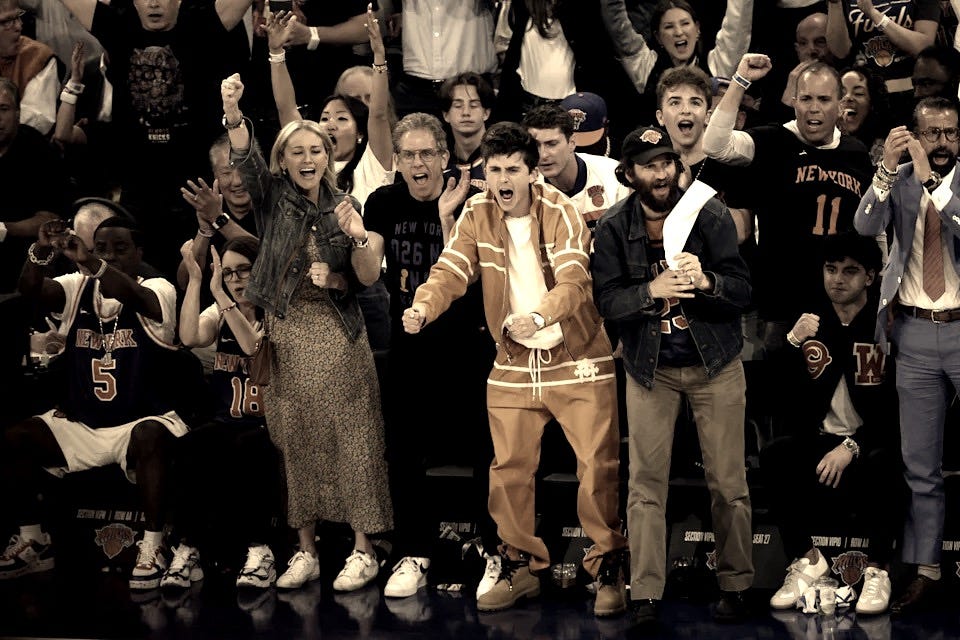
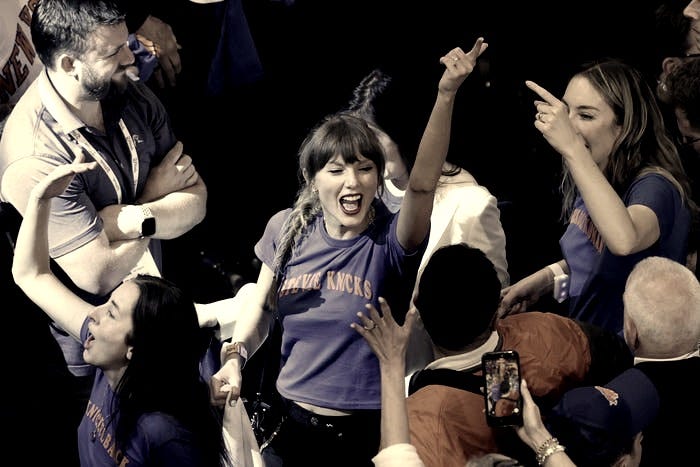
I watch a lot of sports, and I have seen enough games to recognize the rhythm of a real crowd. During the recent New York Knicks playoff run, the energy in the arena completely shifted. It was no longer just about basketball. Everyone from Wall Street to Hollywood suddenly had to be in the building. Nosebleed tickets, the seats normally reserved for the most dedicated fans, were selling for over ten thousand dollars. The courtside area transformed into a celebrity row, packed with people who simply had to be seen there.
We are seeing the exact same phenomenon with the World Cup. Take the upcoming Colombia versus Portugal first round match in Miami. Tickets in the highest upper levels are starting at three thousand dollars. I have spent enough time in Miami to know exactly what that experience actually entails. You have regular people mortgaging their financial stability just to sit in ninety-degree, suffocating humidity. It is physically uncomfortable and often miserable. Having been in those crowds before, I can see clearly just how absurd the reality of the situation is compared to the hype.
Imagine spending that much money and enduring that much friction for a few hours of entertainment. It is as ephemeral an experience as you can possibly have.
All of this happens in the name of the fear of missing out. It is driven by the need to show off and the desperate need to belong. Highly intelligent, successful people get completely caught up in these phenomenons. When you ask why someone would pay twenty thousand dollars for a single ticket, the honest answer has very little to do with the actual value of the event. They are paying that price simply because everyone else wants to pay that price.
The cost of the experience becomes entirely detached from the value of the experience.
People are no longer paying for soccer, basketball, or music. They are paying for status. They are paying for social proof. They are paying to temporarily quiet their own fear of exclusion.
What Is A Mania?
It is easy to look at these events and wonder why otherwise intelligent people lose all of their perspective. But history proves that intelligence offers very little protection against a crowd. Intelligent people bought tulips at exorbitant prices centuries ago. Intelligent people bought worthless technology stocks in the nineties. Intelligent people panic and sell their investments at the exact wrong time.
The issue is not intelligence. The issue is contagion.
A mania is not a clinical diagnosis here. It is simply what happens when social participation becomes far more important than independent judgment. It is a temporary, collective suspension of reality driven by shared excitement.
Humans are deeply tribal creatures. We are biologically wired to fear exclusion because historically, being separated from the tribe was a threat to our survival. When we see everyone rushing in one direction, our instinct is to follow. We use the behavior of other people as evidence of what is true and what is valuable. We constantly mistake popularity for truth.
You hear about an event, you see it flooding your social feeds, and suddenly you lose all contexts. You feel a physical pull to participate. This does not just happen to celebrities seeking attention. It happens to regular fans who drain their savings to buy the love of a family member, or simply to feel like they are part of a cultural moment.
The Hidden Cost
Most people assume the only cost of getting caught in a mania is financial. They assume it is just about the money spent on a ticket, for the sake of the “experience” or a bad investment.
But there is a much heavier, hidden cost behind getting caught in the middle of the crowd. You lose your agency. You surrender your independence. You trade your own clear perspective for the emotional high of the group.
The true cost is the sudden inability to stand still while everyone else is running. You become entirely reactive to the environment around you. Your choices are no longer your own. They are dictated by the shifting current of whatever the collective crowd decides is important today.
Stillness As A Posture
This is where your internal stability matters most. The antidote to a mania is not found in an argument or a financial spreadsheet. The ultimate competitive advantage is stillness.
When I talk about stillness, I am not talking about meditation. This is not a spiritual exercise or generic self-help advice. I am talking about stillness as an act of resistance. Stillness as the ultimate form of independence.
It is the rare ability to observe collective excitement without feeling the desperate need to participate in it.
Stillness should be an inner posture rather than an outer condition. It does not mean you literally stop moving, withdraw from the world, or refuse to participate in the culture. You can absolutely go to the game. You can pay for the ticket and enjoy the spectacle. But you do it because you actively and independently chose to, not because the fear of missing out forced your hand. You retain your executive power while you play the game.
It is not something you wait for. It is something you practice amid the chaos of your daily life. You do not withdraw from the experience. You simply change how you approach everything that comes your way.
The posture of stillness acts as a compass. It is the capacity to let an experience come to you fully. It could be a cultural mania, a sudden demand on your attention, or a sharp emotion. You allow it to arrive without immediately bracing against it or rushing to grab hold of it. You remain in the center of the room, completely engaged, but holding your executive power. You watch the wave crash, but you refuse to let it pull you out to sea.
The Fading Crowd
The cruelest reality of every mania is that it eventually ends. They all fade.
The world moves on. The narrative changes, the hype evaporates, and the crowd rushes toward the next shiny thing. And what are you left with? A memory? A few photos you rarely revisit?
People often justify the madness by saying that life is short and you have to live it. But how exactly are you living it? If your actions are dictated by the fear of missing out, you are not truly experiencing life. You are just trailing behind the crowd.
The experience always ends. What remains is the structural integrity of your own mind. What remains is whether you maintained your perspective while everyone else willingly surrendered theirs. There is immense power in preserving your clarity while the rest of the world loses it.