

The Architecture of Restraint: The Biology of Doing Nothing
Constant motion is a biological sedative. Why doing nothing is the hardest, most vital execution skill a person can possess.


We have been conditioned to always be in movement. We are taught to believe that we can perform at an optimal level at will. The lie we are sold is simple: take the vitamins, eat well, exercise, get a good night’s sleep, and everything will be perfect.
Then you wake up some days and feel foggy in the head. You feel tired even after the perfect night’s sleep and wonder what you are doing wrong. You ask yourself, “What is wrong with me? Am I sick? Am I sub-normal?”. Everyone else seems to be on their game, but today you just aren’t seeing it.
In reality, that is the normal state. We operate in a valley of highs and lows, with everchanging emotions and moods that alter our connection to our baseline of performance. We are simply not built to be in constant motion.
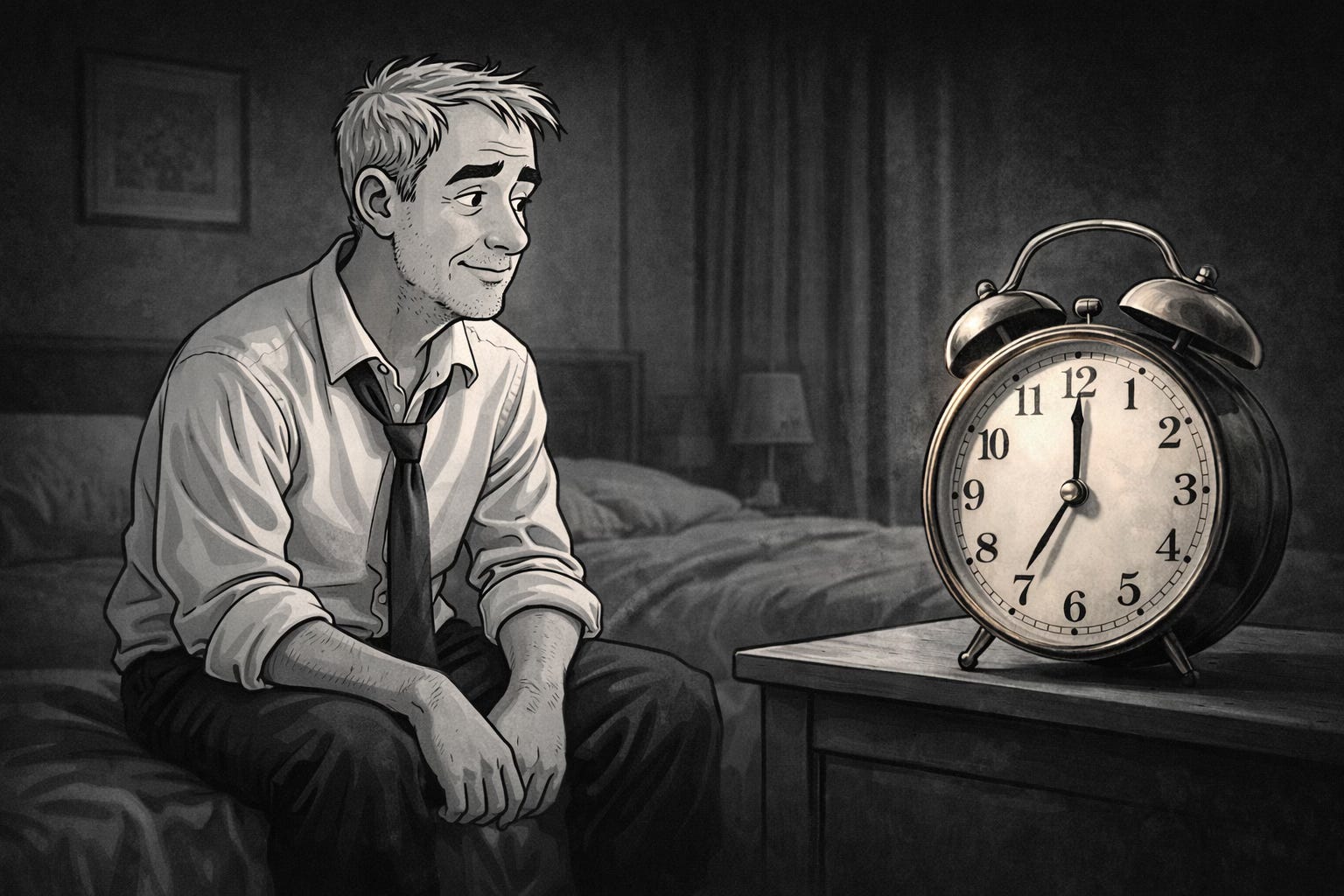
Giovanni Papini’s tale “The Clock that Stopped at Seven” offers a profound analogy for this reality. In the story, the narrator contemplates an old clock in his room that has been frozen at seven o’clock for years. Its hands are forever stuck marking a single instant, while every other clock in the city continues to move. Yet twice a day, when all the other clocks strike seven, this dead clock suddenly seems “in harmony” with the world. Without moving at all, it coincides with moving time, sharing briefly in the universal rhythm.
The narrator sees himself in that silent clock. His life feels mostly empty, broken only by two rare instants a day when he feels completely aligned with the universe—lucid, expansive, and fully alive. Those moments are intense but fleeting; afterward, he returns to isolation while the world moves on. As someone restless by nature, he wonders why heightened living is so rare and why he cannot constantly feel in sync with time.
It is a perfect analogy. Biologically, we are like the clock stopped at seven. We are designed to produce and connect for a limited time, and to stop and recharge for the rest of the day. Yet, we are taught to defy this biology in the name of productivity. We celebrate the executive who sends emails at 2:00 AM and the founder constantly tweaking their systems. We label this relentless output as “hustle” and “focus.”
But if you look closely at the architecture of a sleepwalking high-achiever, this constant action is not focus at all. Far from it. It is a biological sedative. Constant motion is simply a coping mechanism used to avoid sitting alone with their own baseline anxiety.
The Biology of the Void
When you stop and strip away the charts, the emails, the messages, and the “urgent” problem-solving, your brain registers a sudden drop in dopamine and a massive spike in cortisol. To the sleepwalking operator, the void feels like a mortal threat.
This triggers the “Fix It” reflex. Your amygdala immediately screams at you to do something—to make a trade, fire off a message, or pick a fight. You do this not because the action makes strategic sense at that moment, but because the physical friction of the action temporarily relieves the internal panic. You are manufacturing chaos simply to soothe your own biology.
Restraint is biologically expensive. Sitting in a room with your eyes open, fully aware, while your brain demands action requires immense parasympathetic strength.
It is a vital operational muscle, yet it is one that most “successful” people have allowed to completely atrophy.
The Operator’s Reality: The Cage Match
Even with a deep understanding of these mechanisms, restraint remains the biggest challenge I face today. Staying still, doing nothing, and pausing is excruciatingly difficult.
I know it intellectually. I have strict daily slots scheduled for intentional quiet, and I dedicate 45 minutes every Sunday purely to stillness. But let me be perfectly clear: this is not some peaceful, zen retreat. It is a cage match with my own conditioning.
I sit there with my eyes open, nowhere to go, nothing to prove. And immediately, I feel the pull. My brain demands that I reach for the phone, research an idea, or move my body. The urge to be in action is violent, and if I let my guard down, that urge almost always wins.
The mind is incredibly deceptive in how it negotiates this panic. It creates the illusion of productivity to justify breaking the restraint. We tell ourselves we are just “organizing our files,” “optimizing our schedule,” or “researching the market.” But organizing your desk for the third time in a day, or endlessly scrolling through data feeds, is just an acceptable professional form of avoidance. You are hiding in the busywork because you cannot tolerate the silence of the setup.
The cost of this biological flinch is staggering, and it happens across every domain.
It is the independent trader who builds a flawless mechanical system, but the moment the market chops sideways, the silence becomes deafening. They jump in open a trade early, forcing a low-probability entry simply because they couldn’t tolerate the discomfort of waiting.
It is the founder who finally hires a brilliant executive team, but steps in to micromanage a project at the eleventh hour because letting the team execute without them feels too much like losing relevance.
It is the husband or wife who picks an unnecessary fight on a perfectly quiet Sunday afternoon because the peace feels unfamiliar, and the friction of the argument provides a twisted sense of grounding.
In every single case, they are paying the market, their business, or their marriage just to relieve their own anxiety. Doing nothing when the environment around you is chaotic is not a passive act. It is the ultimate flex of decision stability. If you cannot hold your position without mechanically reacting to every stimulus, you are not in control—your nervous system is.
The Protocol: Training the Restraint
Doing nothing is not an absence of skill; it is the ultimate expression of it. To stop paying the market, your team, or your family to soothe your nervous system, you have to actively rebuild your biological architecture.
Strip the Romanticism: Stop treating “quiet time” or stillness as a spiritual luxury or a wellness hack. Treat it as mandatory, structural stress testing for your nervous system. If you cannot sit alone in a room for ten minutes without reaching for a screen, you are biologically compromised. Recognize that your inability to stop moving is a systemic vulnerability.
The Discipline of the Void: Start training this muscle mechanically. Block out 10 minutes. Keep your eyes open. Remove all inputs—no phone, no music, no screens. When the physical urge to grab the phone or check a price hits, do not try to suppress it. Use the Gestalt practice of the “Witness.” Observe the biological panic, feel the adrenaline spike, and watch your mind manufacture excuses to move, but do not take orders from it.
Decoupling Action from Value: You must fundamentally break the subconscious, inherited belief that your worth is intrinsically tied to your output. If you only respect yourself when you are “moving,” you will eventually move yourself right off a cliff just to feel productive.
True discipline is not punishing yourself with endless tasks. True discipline is possessing the emotional amplitude and parasympathetic strength to sit on your hands and let your architecture do the work.
As long as we are trying to achieve a psychological result, as long as we want inward security, there must be a contradiction in our lives. I do not think most of us are aware of this contradiction, or if we are, we do not see its real significance. On the contrary, contradiction gives us an impetus to live; the very element of friction makes us feel that we are alive. The effort, the struggle of contradiction, gives us a sense of vitality. That is why we love wars, that is why we enjoy the battle of frustrations. So long as there is the desire to achieve a result, which is the desire to be psychologically secure, there must be a contradiction; and where there is contradiction, there cannot be a quiet mind. Quietness of mind is essential to understand the whole significance of life.
   - Jiddu Krishnamurti