

The Reversion: Why Success Doesn’t Follow You Home
It isn’t emotional weakness. It is biological efficiency.

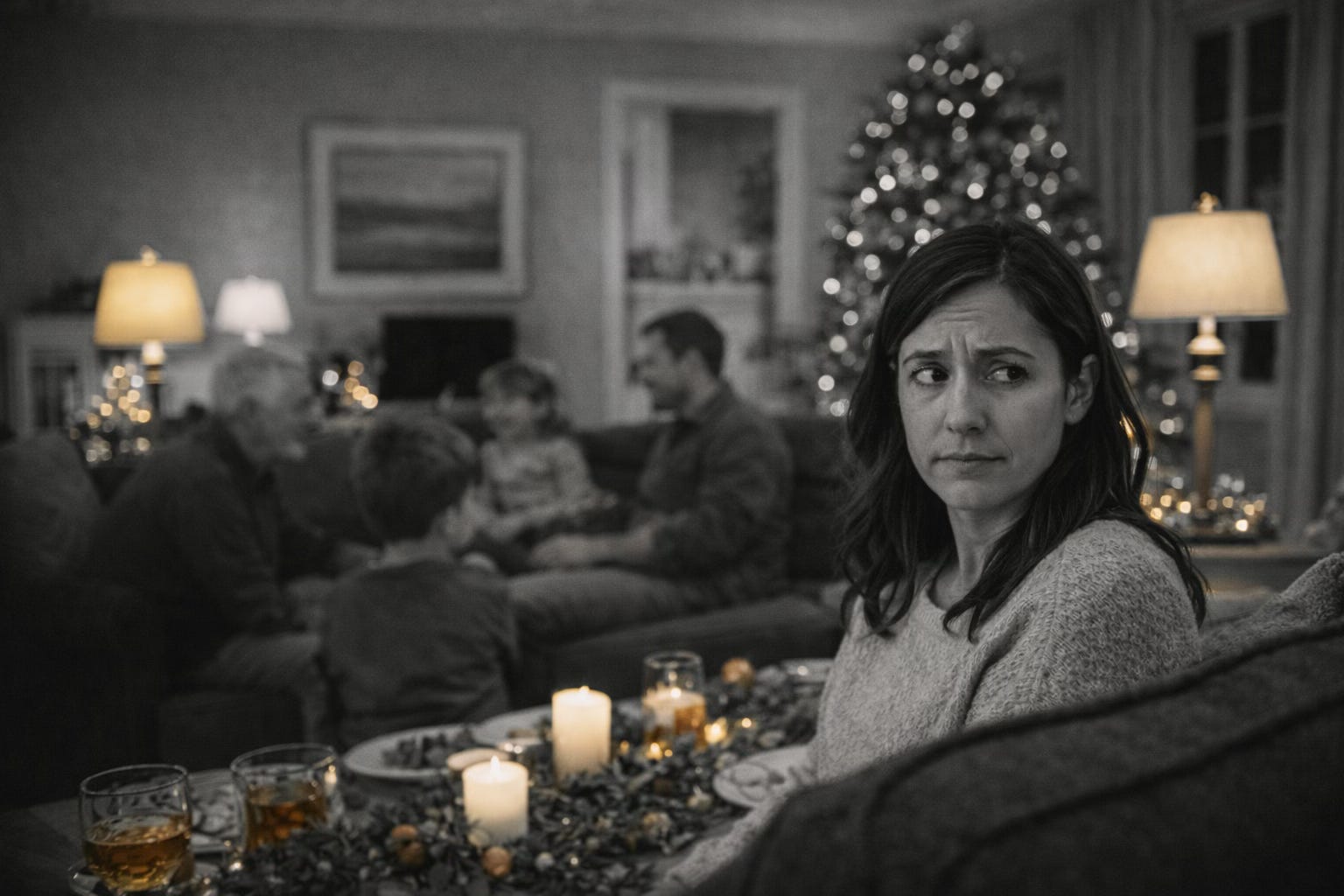
There is a specific phenomenon that happens to high performers in December.
You spend eleven months of the year building and living a sophisticated identity. You are a leader, an entrepreneur, a decision-maker, a parent yourself. You have cultivated “stability.” You handle crisis with a flat pulse. You have built a life that is miles away, both physically and mentally, from where you started.
Then, you book a ticket. Soon after you pack a bag and board a plane. You walk through the front door of your parents’ house.
And in less than ten seconds, the architecture collapses.
Suddenly, you are not the CEO. You are not the calm and controlled stoic, but you are fifteen years old again. You feel defensive, irritable, and small. A simple question (”Did you sleep enough? “Did you eat”?) feels like an interrogation. A simple comment about the news feels like a challenge to your autonomy.
We usually treat this as a moral failing. We think, “I haven’t grown as much as I thought.” Or most common we blame the family: “They still treat me like a child.”
But this isn’t a moral failure. And it isn’t really about your parents. It is a biological mechanism called The Reversion.
As we head into the holiday season, and as I travel into a family wedding this week, it is time to look at the mechanics of why we time-travel against our will, and why the most difficult negotiation you will face this year isn’t in the boardroom. It’s at the dinner table.
The Geography of the Past
I moved away from home at a very early age. I was 17 when I left Colombia for college in Boston.
I never really returned. Save for a few short months immediately after graduation, I have lived my entire adult life elsewhere, in a different country and in different cities, with different roommates, and eventually building my own home in Miami. I have spent decades constructing a separate existence, proving to myself and the world that I am my own man.
Despite not living with my parents since I was 17, and now living even farther away, the “Home Feeling”, or maybe just the “Parent Feeling”, still exerts a gravitational pull on my emotions that logic cannot explain.
Every time I return, whether for the holidays or a special event, I am filled with a confusing cocktail of anticipation and anxiety. Just a few months ago, the whole family gathered for my father’s milestone birthday. This week, we are gathering again for my niece’s wedding.
The context changes, but the pattern is absolute. Anticipation. Then tension. Then regression.
The moment I meet my parents, the feeling arrives. I don’t know why, but I suddenly feel back in the body of a teenager. I feel the urge to get away. I feel a prickly defensiveness, like a kid who doesn’t want to be told what to do.
The irony of course, is that they aren’t telling me what to do.
My parents are lovely people. They are proud of me, and they are not drill sergeants. But the reality of their behavior doesn’t matter. The presence of the family dynamic is enough to override the reality. Despite knowing that I am an adult and a successful entrepreneur, in that setting, I revert back in time. It is how it is.
The Somatic Signal
Having lived apart from them for so long, you would think I had moved on, and not just physically, but mentally. At least, that is what I used to think.
There have been long periods where I haven’t seen them for over a year. Yet, the moment the decision is made to visit, the biological sequence begins.
It starts with the decision itself: I feel a strong, subtle sensation in my chest. A tightening. As the date gets closer, the signal moves up. My shoulders tense. They creep toward my ears, a microscopic defensive posture. Then comes the event itself—entering the city, walking into the hotel or the house. The tension migrates to the neck.
By the time I am standing in front of them, I am on guard. I feel as if I am about to be attacked. From what? I am not sure. There is no enemy here. But I feel under the lens. I feel perceived not as I am, but as I was.
I know not everyone feels this specific tension. For many, going home for the holidays is purely joyful. For me, the joy is there, but it is wrapped in this inexplicable armor. Even when I know rationally that it makes no sense, my body is preparing for a fight that isn’t happening and won’t happen.
For years, I dismissed this. I thought it was just “travel anxiety” or “family quirkiness.” But in the last few months, as I have gone deeper into the study of biology and neuroscience, I have begun to connect the dots.
It makes no sense to feel defensive when the occasion merits joy. But biologically, it makes perfect sense.

The Science of the “Old Coat”
We tend to think of memory as a photo album we flip through. But the nervous system doesn’t just “remember” the past. It uses the past to predict the future.
In neuroscience, this is known as Predictive Processing.
The brain is, above all else, an efficiency machine. Its primary goal is not “Truth.” Its primary goal is to save metabolic energy and thinking is expensive. Analyzing a situation in real-time burns calories (glucose) that the brain would rather conserve.
So, the brain builds maps. When I was in Miami and now in Charlotte, running my business and living my life, my brain uses the “Adult Jacques” map. It is a map forged over the last 20 plus years and it works.
But when I walk into my parents’ presence, my brain recognizes the terrain. It says: “Wait. I know this place. I have a map for this. I have a high-speed neural highway built over 17 years of repetition.”
That highway is the Teenager Operating System.
It doesn’t matter that the map is outdated. It doesn’t matter that I haven’t been that person for decades. To my brain, that map is cheap to run and It is the path of least resistance. Why would the brain spend expensive energy trying to figure out who I am today, when it can simply load the operating system of who I was then?
This is why the tension starts in the neck before anyone speaks. The tension is not a reaction to my father saying something. It is a prediction that he might.
My body is budgeting energy for a conflict that hasn’t happened yet and will not occur most probably. I am not reacting to reality; I am reacting to a ghost. The “Reversion” is simply my biology choosing efficiency over accuracy.
The Conflict with the Ghost
This insight changes the game, and believe me, it has for me. The moment you realize that your irritation isn’t about your mother’s comment, but about your prediction of her comment, the conflict shifts.
You are not fighting your family. You are fighting your own pattern recognition.
When we go home for the holidays, we are walking into a museum of our former selves. Everyone in the family has a role. The “Responsible One.” The “Messy One.” The “Quiet One.” These roles were assigned when we were children to help the family system function.
When you walk in the door, the family system hands you your old costume. “Here,” the dynamic says. “Put this on. It’s easier.”
The tension I feel in my neck is the friction of trying not to put the costume on. It is the “Adult Self” fighting the “Child Self” for control of the steering wheel.
The Protocol: Strategic Tolerance
So, what do we do with this? I am heading to a wedding this week. I know the trigger is coming. I know the shoulders will go up.
The goal isn’t to eliminate the feeling. That is impossible. You cannot willpower your way out of a 30-year-old neural pathway. The goal is Strategic Tolerance.
1. Expect the Reversion. Do not be surprised when you feel 15 years old. Expect it and when the irritability rises, don’t judge it. Say to yourself: “Ah. There is the old map. My brain is trying to save energy.”
2. Watch the Grip. Monitor the somatic signals. The moment I feel my neck stiffen; I have data. That tightness is not “Truth.” It is just a biological alarm bell ringing in an empty room.
3. Do Not engage with the Ghost. When you feel the urge to snap back, or to defend yourself, or to prove how successful you are—pause. That urge comes from the teenager who needed to prove himself. The man does not need to prove anything. The man can smile, breathe, and let the comment pass.
The Invitation
This holiday season, you will likely find yourself in a room where you feel smaller than you are. You will feel the old costume waiting for you.
You don’t have to wear it. But you also don’t have to burn it.
Just notice it hanging there. Acknowledge that it kept you safe for a long time. And then, politely, with the stability of the person you have become, step past it.
Enjoy the holidays. Watch your neck. And remember: You are not who you were. You are who you are now.