



Peter Thiel famously argued that the only real technological progress we’ve witnessed in the past half-century can be narrowed down to the little screen we all carry around in our pockets. His stagnation thesis suggests that true physical innovation has stalled since the 1950s. Our culture’s vision for progress has shrunk so dramatically that the only visible proof of advancement most people can point to is the phone in their hand.
We celebrate faster chips, sharper screens, and more addictive apps, but these upgrades sit atop a physical world that looks eerily the same: the same roads, the same fragile power grid, and the same slow infrastructure. In Thiel’s framing, this isn’t just a story about missing inventions. It is a story about our imagination shrinking until “innovation” simply means rearranging icons on a glowing rectangle. We are a civilization that once aimed at moon landings, but now we treat a slightly better smartphone camera as a triumph.
I agree with Thiel. The most significant technological change in the last fifty-plus years is our ability to stream all sorts of endless content at any time. An evolved television with endless choices is truly all we have to show for it. While we live much more comfortably than we did 75 years ago, the true, hidden cost is that we have lost our attention and our capacity to focus. That little screen, controlled by a handful of companies, has completely captured our focus.
The Normalization of the Zombie State
The worst part is that we are now led to believe this is normal. We see it all over—the complete normalization of our inability to hold attention.
Recently, I watched a Netflix comedy special by Marcello Hernandez, a comedian of Cuban origin and a cast member on Saturday Night Live. He did a bit about how, when he was young, he struggled to focus and actually wanted to have ADD (Attention Deficit Disorder) because “everyone had it” and he wanted it too. Unfortunately for him, he joked, his mother didn’t allow him to have it.
It is incredibly funny, but deeply sad when you examine it further. We have lost our capacity to focus, and it is now not only common but socially acceptable. Unless we understand the biological “how and why,” we are destined to continue living with the anxiety this causes, disconnected from reality in the zombie-like state we see everywhere we look.
The Biological Trap: Threat Detection Mode
The root of the problem is physical. By focusing on your screens all day—whether it is the phone, the computer, or the tablet—you severely narrow your field of vision. When you lock your eyes onto a small space, your brain interprets this as a signal to go into “fight or flight” mode.
Biologically, your brain thinks you are either hunting or being hunted. You might think you are simply “focusing” on work, but you are actually in the exact opposite state of calm. Your mind has been taken over. This progressive hijacking started with the advent of the computer, intensified with smartphones and social media, and fully calcified with “work from home” policies.
Millions of people now sit alone in home offices, coffee shops, or cubicles, staring at screens for hours on end. Look closely, and you’ll realize most cannot hold their attention for longer than 30 minutes. They inevitably start browsing, shopping online, or swiping through short videos on their phones.
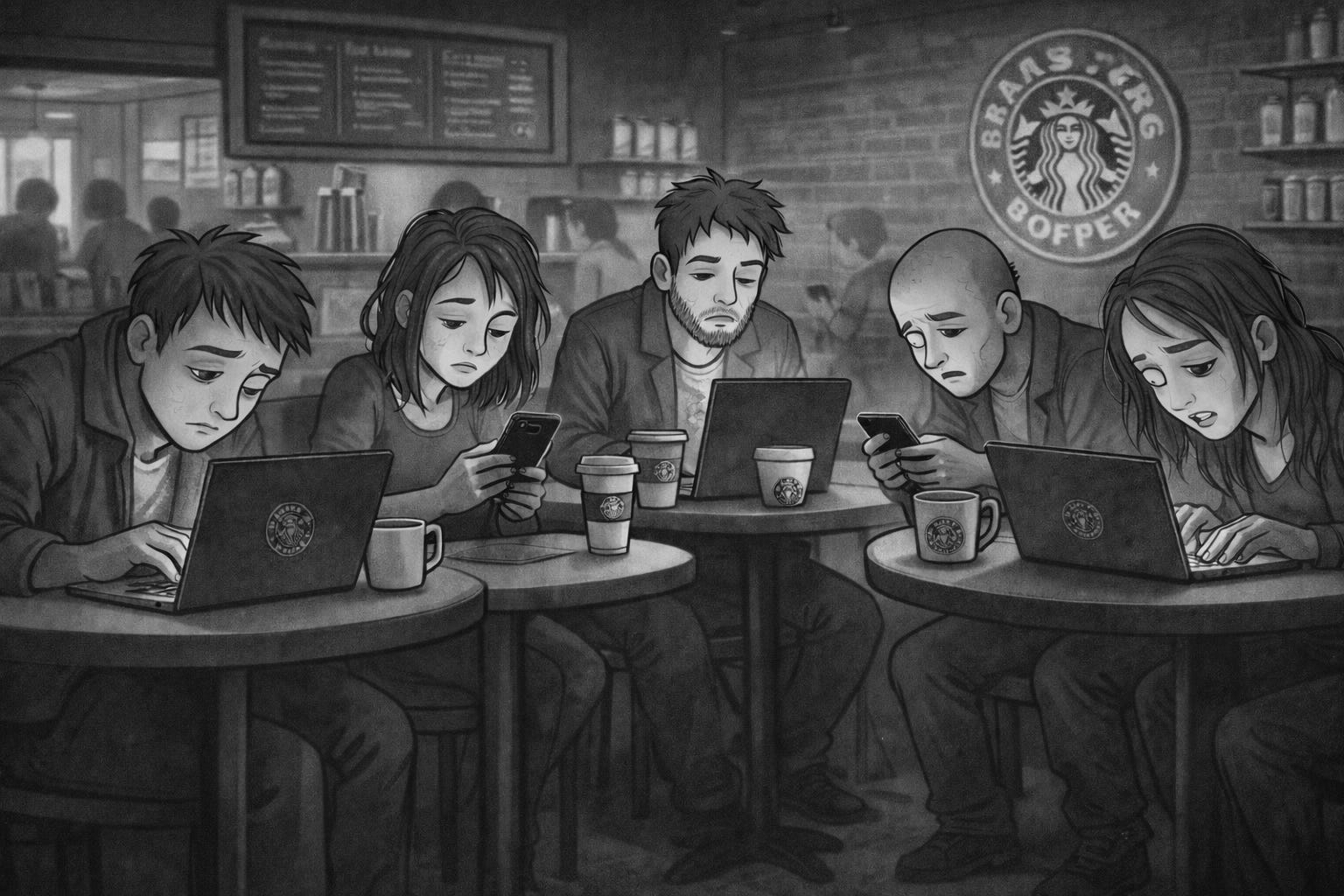
You start your morning with the best intentions, but after that first long session locked onto a screen, you inadvertently activate your sympathetic nervous system. You cannot exit this “hunting mode” simply by continuing to look at that same narrow visual field for hours.
Between a typical 8-hour workday and your free time, you might spend up to 12 hours in “focal lock”. You are silently screaming “threat” to your brain. Even if you don’t consciously feel in danger, your nervous system registers the visual narrowing as a threat. This triggers the release of adrenaline, keeping you agitated and activated. This is precisely why you feel a compulsive force drawing you back to the screen; you literally cannot calm down if your eyes are physically locked in “Threat Detection” mode.
The Witness: The Trading Floor and The Horizon
I see this reality in my own experience all the time. Trading requires focusing on complex charts on a screen for extended periods. At first, I assumed my stress was caused solely by the ups and downs of the market and my own inability to handle uncertainty. But as I sought to improve my performance, I learned about the severe physiological effects of staying glued to the screen.
I used to wonder: Why do I feel so clear and calm after working out in the morning? And why does that clarity vanish just a couple of hours into my working session?
The answer was in my eyes. All those years spent staring at screens had narrowed my field. “Tunnel Vision” wasn’t just a psychological metaphor; it was physical. The adrenaline was being locked in by my eyes.
Now, when I exercise in the morning, or when I force myself to take a long break throughout the day and go outside, that neurological hold softens immediately.
Moving through physical space, seeing the horizon, and letting my eyes scan wide literally “washes” the stress out of the visual cortex. I realized I wasn’t running away from stress; I was literally looking away from it. This is Optical Flow.
The Philosophy: Architecture of the Senses
You need to literally “look up” to solve problems. This is the essence of what I call the Architecture of the Senses.
Inner Architecture: We are meticulous about designing our physical offices, but we completely fail to design our visual intake.
The Box: Consider the geometry of modern work. If you live in a box (your room) and stare at a box (your screen) all day, you will inevitably think inside a box (anxiety). You cannot engineer high-level, creative solutions when your sensory input is constrained to twelve inches.
The Shift: To change your mind, you must literally change your view. Expanding your visual field is the biological override switch that signals safety to your nervous system.
The Protocol: The Anchor
Understanding the biology is only half the battle. You must build a system to break the focal lock. Here is the operational protocol to master your visual architecture:
1. The Horizon Rule: You must see a horizon line at least once a day. This is non-negotiable. Letting your eyes focus on a distant point mechanically flattens the lens, triggering a massive parasympathetic (calming) response.
2. The Soft Gaze: This is the “cool” executive hack for navigating a stressful meeting. When tensions rise, purposefully widen your peripheral vision. Keep your focus on the speaker, but consciously become aware of the walls, the ceiling, and the space around you to prevent emotional hijacking.
3. The 20-20-20 Reset: This is your tactical breaker for screen apnea. Every 20 minutes, force your eyes to look at something 20 feet away for 20 seconds. It forces the visual system to exit “hunting mode” before the stress compounds.
Conclusion
To be clear, widening your gaze will not miraculously fix a broken trading strategy or erase all of your executive anxiety. Your visual field is simply one pillar of your Inner Architecture, designed to work in tandem with the other systems we are building, like your Information Diet and your Decision Battery.
However, taking control of your optical flow is a vastly more powerful biological lever than we have been led to believe. You cannot out-think a nervous system that is visually locked into a state of continuous threat. But when you finally align your physical environment with your cognitive goals, you stop fighting your biology and start operating with sustainable clarity.