


I was recently introduced to the work of Jorge Bucay, an Argentinian therapist and author who uses fables to dismantle complex psychological knots.
During a recent deep dive into his work, one specific line stopped me cold. He argues that modern society has a pathological obsession with “effort.” We believe that unless we are suffering, we aren’t working. We believe that value only comes from struggle.
Bucay dismantles this entire belief system with five words:
“Effort is only for the constipated.”
It sounds like a joke, but he uses it to illustrate a profound truth about how we confuse “labor” with “outcome.” He tells the story of a man who worked as a doorman at a brothel. The man was illiterate, but he was loyal and diligent. He had held the post for decades.
One day, the old owner died, and a new, corporate-minded owner took over. He called the doorman in and said, “I need you to sign this employment contract.” The doorman replied, “I can’t. I don’t know how to read or write.” The owner fired him on the spot. “I can’t have an illiterate employee,” he said.
Devastated, the man went home. He had never done anything else. He looked around his house and realized he needed to fix a broken table, but he didn’t have any nails. He walked two days to the nearest town to buy nails. When he returned, a neighbor asked, “Can you sell me some nails? It takes two days to go to town.” The man said yes. Then another neighbor asked. And another.
Realizing the opportunity, the man began traveling to town, buying tools and hardware, and reselling them. He eventually opened a hardware store. Then a manufacturing plant. Ten years later, he was one of the most successful industrialists in the region.
He donated a new wing to the local town hall. The Mayor, deeply impressed, handed him the guest book. “Please, sign the first page for history.” The man smiled and said, “I can’t. I don’t know how to read or write.” The Mayor was stunned. “You built this empire without being able to read? Imagine what you would have been if you could read!” The man laughed. “That’s easy. I would be a doorman.”
The Cult of the Grind
We love stories about “The Grind.” We are raised on a diet of Industrial Work Ethic that tells us: The harder you work, the more you achieve.
You see it on X (Twitter) every day. The “Hustle Porn” gurus preaching 4:00 AM wake-up calls and “sleep when you’re dead” mentalities. We wear our exhaustion like a badge of honor. We measure our worth by our sacrifice.
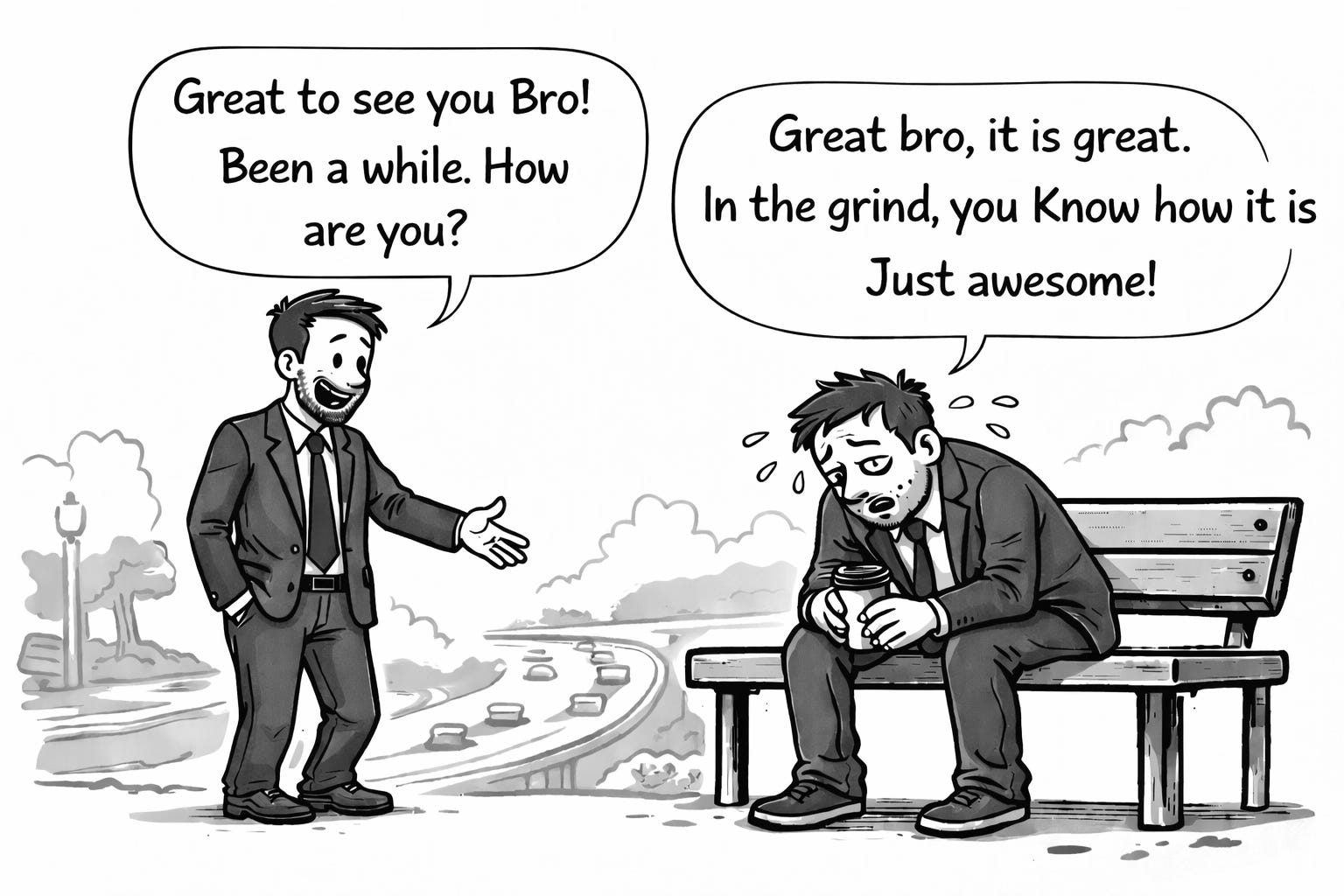
And here is the trap: For 99% of human history, this was true. If you are digging a ditch, digging for 10 hours yields exactly twice as much result as digging for 5 hours. If you are working on an assembly line, 100 widgets is better than 50 widgets.
But in high-performance fields—trading, strategy, creative execution, and leadership—this linear equation breaks. In fact, it reverses.
Effort does not equal Outcome.
In the cognitive economy, you are not paid for your sweat. You are paid for your decisions. And unlike a diesel generator, your brain cannot produce infinite power just because you demand it.
The Biology: You Are a Battery, Not a Generator
We tend to think of our “energy” as physical. We know when our legs are tired. We know when our back hurts. But we rarely acknowledge when our decision engine is tired.
The Prefrontal Cortex—the CEO of your brain—runs on a finite supply of glucose. Every time you inhibit an impulse, regulate an emotion, or make a choice, you burn fuel. Crucially, the brain does not distinguish between “important” and “trivial” decisions.
Deciding what to wear in the morning.
Deciding which route to drive to work.
Deciding whether to sell a $10M position or hold it.
All of these pull from the same battery.
When that battery gets low, you enter a state of Decision Fatigue. The brain, trying to conserve energy, stops doing the hard work of “critical thinking” and defaults to the path of least resistance: Impulse.
This is why you stick to your diet all morning (High Battery) and then binge on sugar at 9:00 PM (Low Battery). It isn’t a lack of “willpower.” It is a lack of fuel.
The Witness: The 18-Hour Myth
I saw the cost of this “battery failure” firsthand during my career in TV production.
In the entertainment industry, the deadline is God. If the show airs on Tuesday, it must be done by Tuesday. This culture bred a toxic reverence for the “All-Nighter.” I witnessed multiple work sessions that lasted over 18 hours. We would order dinner, drink coffee, and push through into the early morning hours.
At the time, we felt heroic. We felt we were giving “maximum effort.” But looking back, I see the reality. Around hour 12, brilliant creative directors—people with immense talent—would turn into toddlers. They would get irritable. They would fight over trivial edits. Or worse, they would become passive. They would approve a bad cut just to make the pain stop.
The product always suffered. We weren’t producing excellence; we were producing compromise. We were throwing “effort” at the problem because we had run out of “clarity.”
I see the same thing now in the corporate world. The “Dinner with Partners” that drags on until midnight. Everyone is tired. Everyone is depleted. Yet, we try to make strategic decisions over the third glass of wine. The brain is in rest mode. The “Executive Function” has left the building, leaving only the “Emotional Center” in charge.

The Micro-Leakage: Why You Are Irritable at Home
This doesn’t just destroy your work performance; it destroys your home life. Think about your typical day. You spend 10 hours draining your battery at the office. You handle crises, you answer emails, you manage egos.
You come home feeling “physically” okay, but mentally hollow. Then you walk through the door, and you are hit with a new wave of decisions:
“What’s for dinner?”
“Can you sign this permission slip?”
“How should we handle this issue with the kids?”
Because your battery is at 0%, you snap. You get angry at small things. You check out and doom-scroll on your phone instead of engaging. You aren’t a bad person. You are just a depleted one.
The Protocol: Protecting the Charge
If we accept that biology always beats willpower, then the goal is not to “try harder.” The goal is to manage the battery so that your best energy is applied to your biggest decisions.
Here is the protocol I use to stop acting like the “Constipated” hard worker and start acting like the Industrialist:
1. The Macro: Real Recovery
Burnout isn’t a sign of weakness; it’s a sign of debt. You have borrowed too much energy from the future.
Take vacations. And I mean real vacations. And often, not just once a year.
If you are checking email on the beach, you aren’t on vacation. You are just working from a better location. You need to fully disconnect to reset the baseline.
2. The Micro: Automate the Mundane Steve Jobs didn’t wear that black turtleneck because he loved fashion. He famously said he didn’t want to waste energy deciding what to wear every morning. He was budgeting his glucose. Look at your day. What can you automate?
Eat the same breakfast.
Wear a “uniform” (simplify your wardrobe).
Block out your “High IQ” hours (usually morning) for deep work, and save the low-value admin tasks for the afternoon slump.
3. The System: Gentle Start, Harsh Stop
I recently implemented a system to save me from my own addiction to “effort.”
I realized that I would often keep trading or writing well past the point of diminishing returns, simply because I felt I should.
So, I set a series of alarms.
The Start Tone: A gentle, inviting melody. This signals that the battery is fresh, and it’s time to flow.
The Stop Tone: A harsh, loud, jarring noise.
Why the harsh noise? Because my brain wants to ignore the signal. It wants to say, “Just one more hour.” It wants to feel the “constipated” satisfaction of effort. The harsh noise breaks the trance. It reminds me that stopping is a discipline.
Conclusion
We have been lied to. We have been told that the person who sweats the most wins. But in the game of high performance, the person who sees the clearest wins.
You can make all the effort in the world, but if your battery is dead, you are just digging a hole in the wrong place.
Don’t be the doorman. Put down the shovel. Guard your battery.